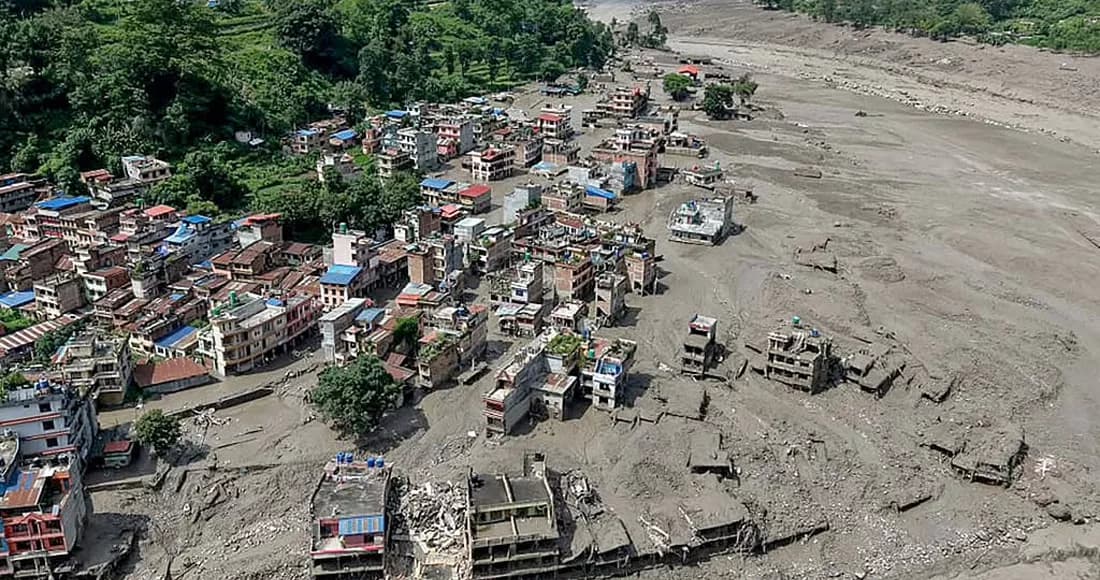

Photo source, Reuters
Even after nine days of people being trapped in the tunnels of various hydropower projects and the production centers ('powerhouses') inside them, more than four people have not been rescued alive, officials said.
According to the Nepali Army, three bodies were recovered from the tunnel structure of various hydropower projects. The promoter of the project said that two more bodies were removed from the tunnel of the Langtang River Hydropower Project on Thursday.
Why are the rescue workers unable to reach more than 150 people who are believed to be trapped in the hydroelectric tunnel after several days of efforts?
The BBC asked tunnel experts, people at the rescue site and officials about it.
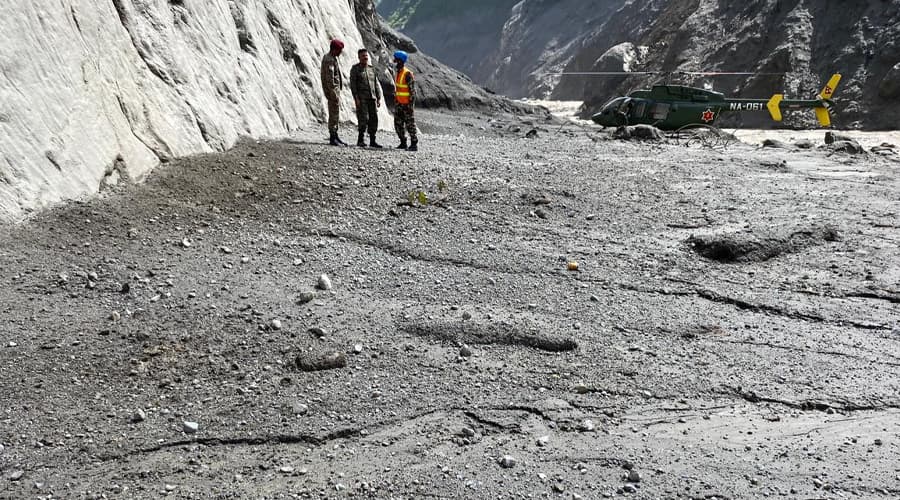
Image source, Nepali Army
On the ninth day of the flood, on Thursday, the Nepalese army pulled out the bodies of two people from the tunnel of the Langtang hydropower project in Rasuwa.
Earlier, when rescuers tried to enter the project through a flooded tunnel, they could not go more than 100 meters inside.
Vijay Mohan Bhattarai, managing director of the project, told BBC Nepali that if the Nepalese army had given permission to take experts and technicians to the project itself, many people trapped inside the tunnel could have been rescued alive.
"We have been saying from day one that we should take our technical people. Hydropower is not a structure like any other. We feel that many people could have been saved if we had been given permission," says Bhattarai.
Bhattarai claimed that after the project allowed itself to take equipment and technicians, they made a way to reach the place where the people were trapped.
"Our technical team entered through the bifurcation pipe and reached up through the penstock pipe and made a hole there. We made a hole where people were trapped, where we knew people were trapped. The army is entering from there and removing the bodies," said Bhattarai.
According to him, the bodies of two people were found within 150 meters of the tunnel where they were suspected to be earlier.
A 150 meter long tunnel was built above the powerhouse to reach the mouth of the 'penstock' pipe used to send the water brought from the tunnel to the powerhouse at high speed. The project claims that 15 people working at the same place are without contact.
According to the assessment of officials and project managers, people are trapped in the tunnels or powerhouses inside the tunnels of five of the 12 hydropower projects in Rasuwa and Nuwakot in the Bhotekoshi-Trishuli watershed.
More than 150 people are believed to be trapped in the Rasuwagadhi, Langtang Khola, Chilime, Upper Trishuli 1 and Trishuli 3A project tunnels or related structures.
Shriram Neupane, a tunnel engineer who is also a Member of Parliament, says that it was not possible to enter inside the tunnel due to the flood and 'Gharjatra' bringing large stones and piling them outside the tunnel of the hydropower project.
Neupane, who is coordinating the rescue in Upper Trishuli 3 'A', said that it took time to find the mouth of the tunnel in the project.
He says that different measures have been taken in other tunnels as well according to the characteristics of the tunnel.
"Inside the tunnel facing the direction from which the Trishul flowed, there is mud, big stones and gegran. When they go inside, there is water at the top and debris and stones at the bottom," Neupane says.
"Trained rescue teams are supposed to go there. But tunnels filled with lava require extraction techniques and machines."
The Nepali Army has said that the necessary equipment could not be transported due to the 'destruction' of the road beyond the headquarter of Nuwakot.
The spokesperson of the Nepali Army, Rajaram Basnet, also said that there is no place to keep helicopters and equipment to remove objects accumulated inside the tunnels at the mouth of several projects.
"There is not even a place to land a helicopter at the entrance to the tunnel. Therefore, we have not been able to open the barrier inside the tunnel by taking large equipment," Basnet told BBC News Nepali.
Military spokesman Basnet said that so far four people have been rescued alive from inside the tunnel and 289 people have been rescued alive from the tunnel area.
Chhatra Basnet, a tunnel engineer, says, "The mouth of the tunnel in the hydropower projects located in the upper part has been washed away. Because of this, there was no 'platform' to keep the helicopters. The process of deposition started from the upper Trishuli 3 'A', i.e., the process of piling the goods brought from above," says Basnet.
"Since the mouths of the tunnels of our hydropower project are facing the river itself, the rescue work in the tunnel has become complicated as mud, stones and other things brought by the river have entered from there along with the flood."
The main entrance of Upper Trishuli 3 'A', where about 25 people were believed to be trapped in the powerhouse inside the tunnel, was 30-35 feet above the surface of the river. Nine feet above the main entrance was another cable tunnel. But now even more than that, the flood has brought big stones, gegran and concrete slabs up to 40-50 feet higher than that, says Suresh Raut, co-manager of Nepal Electricity Authority, who is at the project site.
Similarly, in the upper Trishuli 1 project, where the maximum number of 115 people are believed to be trapped, workers are believed to be trapped in the four-kilometer tunnel area between the spring that lets water in from the river and the first audit tunnel. Giriraj Adhikari, general manager of the project, says that the place is covered with big stones, gegran and mud and the machines and trucks used in it got stuck there.
Families of people trapped inside the tunnels are complaining about the government's delay in bringing in international teams of experts and technical equipment.
Small sophisticated equipment that can be carried inside the tunnels provided by the US arrived in Kathmandu only on Wednesday. Earlier, there were reports that the technical rescue team from Korea could not proceed with the work due to lack of equipment.
"They are using their resources, but the right tools and equipment, the right manpower and the right method seem to be lacking," says Basnet, a tunnel engineer.
"It would be better if the right people were deployed at the right time for search and rescue. That is a major task that should involve the team including the project designer, engineer and construction manager. But without the right equipment, no one can do anything. There is a lack of use of equipment at the rescue site."
MP Neupane, who has worked as the head of the Nagadhunga road project, says that Nepali people have already built more than 400 kilometers of tunnels, but the rescue is taking time due to the level of landslide and flood damage.
"Even if we have all the equipment, we cannot dig more than 80 to 100 meters of tunnel in a day. It is faster to open than to dig, but there is a problem in going there and delivering the equipment. Another thing is that we don't even have the latest equipment," he said.
Image source, NepaliArmy
Giriraj Adhikari, Managing Director of Langtang River Project, says that the current disaster has taught Nepali a great lesson. He gave the example of the safe rescue of people buried in coal mine tunnels in several countries and said that the rescue process of Nepal should be reviewed.
"Now there is no point in blaming anyone. But I thought the Nepalese army was good at it. But they should have only rescue personnel, no equipment," he said.
Earlier, Prime Minister Walendra Shah 'Balen' said that although helicopters were mobilized for search and rescue in the tunnels of the power project in the affected area, the rescue was difficult due to the complex terrain. But some are questioning the government about the involvement of the private sector in the rescue and the delay in bringing in foreign experts and equipment.
"The time has come to think whether we used the right method in the rescue or not. We made a method of digging tunnels, but it also made us realize that we need to make a method of what to do in the place of confinement," says Basnet.
Basnet, a tunnel engineer, says that the current incident has taught a great lesson to plan for the future.
BBC News Nepali is also on YouTube. Click here to subscribe to our channel and watch published videos. You can also find our content on Facebook, Instagram and Twitter. And you can listen to the program of BBC Nepali Service at nine o'clock in the evening on the radio from Monday to Friday.