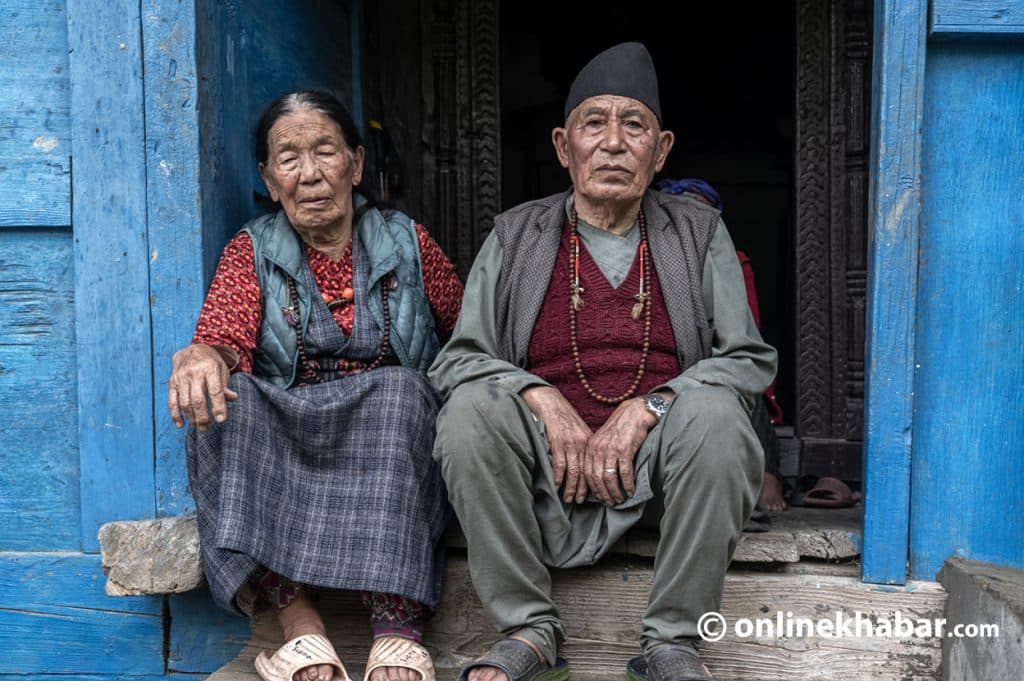
17 August, (Saphrubaceae) Rasuwa. 91-year-old Dawa Phinzo Tamang, who needs help to walk, was going from house to house of his neighbors.
When Unlaikhbar's team reached Rasuwa's Sano Bharkhu village on Tuesday afternoon (Gosaikund Rural Municipality-5), he narrated his painful compulsion. "A neighbor has also lost a son there," he said, taking a long breath, "the daughter-in-law keeps crying, and reminding her to come...."
The neighbor's son (who was the driver) is missing when the flood in Bhotekoshi washed away the Syafru market. A 24-year-old young man who has started to take care of the house is not easy to remind the mother who lost her son, the tears have not stopped.
But based on their experience and age, they keep reminding them of the claim day by day. While the claim has its own pain no less than others.
Taking care of his 86-year-old wife, Chenga Yangzhen, he said, "Would you walk to remind others or remind yourself?"
Dawa's son Phurpasang had a hotel in Syafrubesi, Buddha Guest Hotel.
Grandson Tindu Tshiring started to take over the hotel business, which was prospering from ancestral property and hard work of four generations.
He was amazed at the grandson's hard work more than his son, Dawa.
"My grandson knew many friends. The hotel used to be filled with buses going to Mansarovar,' Dawa recalls, 'People coming from Kathmandu used to stay in the hotel with the same name as Natika.' People coming from China, India and other countries also stayed in the same hotel.
The son and grandson told Dawa and Chenga to rest in the hotel. Dawa and Chenga also enjoyed living in Syafrubesi as two grandchildren were growing up.
"The biggest hotel was my son's," Dawa said, "Buhari was honored as the number one hotel in Rasuwa only."
The couple was happy with the progress from their ancestral home in Bhiralo Bharkhu village up from Syafru Bazar to a multi-crore hotel business.
As he grew older, problems appeared in Dawa's eyes. Son Phurpasang took him to Kathmandu for treatment. Syafru returned on August 5 after the last treatment - Dawa and his wife Chenga.
At that time, a relative 'died' (a relative died) in Bharkhu village. Instead of resting in the hotel, they went to their ancestral home to pay their condolences. Son Phurpasang had come to Bharkhu to leave his parents.
However, less than a week later, on August 10, an unimaginable incident happened. A storm came in Bhotekoshi, swept away Syafrubazar.
"There was a sound like a helicopter, when I looked out, it was full of clouds," says Chenga, "It's gone."
After the flood, there was no Syafra market. There was no possibility of her crying while describing all these memories like a scene.
"Son Phurpasang, daughter-in-law Chhetin, grandson Tintu Tshiring, granddaughter-in-law Yangji, great-granddaughter Kalsang and a working man," says Dawa.
It was hoped that they would be trapped somewhere in the forest for four/five days. But hope is dying as days pass.
Chenga says, "Phurpa said he would come to pick it up after a week...."
The young children of the village took pictures of the Syafra after the destruction and showed it to these two old people. "There is no such tall hotel," Chenga wondered, "What could have survived!"
The Dawa couple's desire to stay for a week saved them. But they cannot bear the pain of losing their own three generations after living at the age of almost 100 years.
His two sons (one lives in UK and the other lives in Australia) are preparing to return to Nepal. It was not even possible to give this news to the younger grandson who is studying in Kathmandu.
Dawa's ancestors, who had been living in Barkhu for 15 generations, had never faced such a crisis. Bhotekoshi was not mad like this even in the memory of his 91-year-old Dawa.
"Our ancestors came here from Nuwakot 15 generations ago," says Dawa, "If there was such a crisis, we would have left here." Even in his memory, there was a big flood in 2018. Then came last year. But both the floods did not wash away the water.
However, our ancestors used to tell us that if the glacier breaks, there will be a flood that will wash away bridges, villages and roads. I had heard one thing - that the ghambal (floods caused by the breaking of snow) goes over the bridge. This time it happened like that," he says.
The flood of Bhotekoshi has taken away someone from every family of small Bharkhu. Like Dawa, his neighbors Mewang Tamang and Gandhram Lhamo have lost their sons. "In this small village of ours, Varke, only 35 people have been lost," Mewang said.
As the Tamang community lives in Sano Varkhu, they calculated the number of those lost in the flood. Even if they could not come to the rescue, they have counted the members who did not come in contact in the list of missing persons.
Where to go to find? How to go?,' says Mewang, 'even if the voice of voting is heard, the people of the house are afraid.'
When the Online Khabar team returned from Mewang's house, they were looking at each other's polls.
Bharkhu's Dawa Phinjo, Mewang Tamang and Gangdhram Lhamokai, the entire Syafru village is suffering. Dawa Mingmar Tamang, the ward head of Syafru (of Gosaikund rural municipality-5), is missing. Pratima Tamang, the vice president of Gosaikund Municipality (local to Safruk), has disappeared.
How many others lost? It is not possible to keep the statistics of how many people were found alive and dead. Accounts of missing relatives are kept in their own way.
"Thankfully I survived, but all my relatives are gone," says Tharzen Dolmo Tamang, whose house is a little above the Syafrau bank, crying.
She was an administrative assistant at the Chilime hydropower project and was preparing to go to the office before the flood. But she managed to escape. "My house is covered with mud. I can't even remember that day,' says Tharjen, 'six heads of the office are locked inside the power house.'
Despite many efforts of the Nepali Army and the Electricity Authority, the people trapped inside the power house could not be rescued. "Everybody from the office and the house disappeared. As we watched, our settlement and market were all washed away," he says. "Now there was a market, big hotels and houses in the place where it was washed away."
Thargen's sister's son, Nanda, and Nanda's husband are buried in Syafrum. "Now Aash is dead. It's been a long time," he says.
According to the statistics of Gosainkunda rural municipality, the population of Syafru is 2,462 people. 450 of them were elderly people. It is not possible to estimate how many of them survived.
The flood has geographically divided Syafru into four parts. Bhotekoshi's waripari was not something that could be done. The Bharkhu Khola Bridge of Syafru Bazar Dobhan was also swept away by the flood, and Syafru has been divided into two more parts. That is, you cannot reach anywhere by walking.
Due to the breakdown of connectivity such as telephone, roads, bridges, even members who are alive are not able to meet. "If there was a bridge even if it was a swing, a road even if it was unpaved, and an environment where the phone could be heard, the survivors would have been able to breathe," says Mewang.
While one of the main roads connecting Nepal with China (Pasang Lhamu Highway) runs through Syafru, the local people here never imagined such a crisis.
Most of them were involved in the hotel business. Then he was dependent on transport labor and agriculture. The family members of the farmers also worked in the hotel, transport labor and hydropower projects on the steep land above the Syafru on the banks of Bhotekoshi. Those who work in these three areas have been swept away by the flood.
Photo/Video: Kamal Prasain/Online News
Rai is the political bureau chief of Online Khabar.
Choulagai, who is affiliated with online news, writes a pen on health wit.