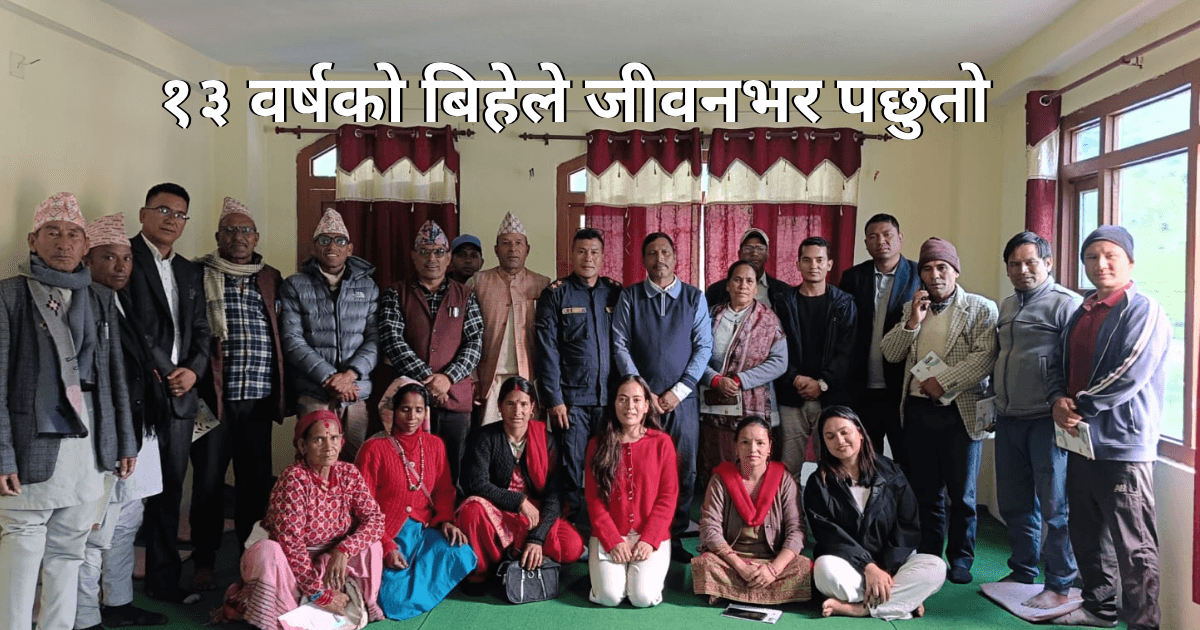
72-year-old Manprasad Sharma of Ranukhana village, Sinja Rural Municipality-2, Jumla now sinks into deep regret when he remembers the past. He married an 11-year-old girl when he was 13 years old. He says that he and his family had to suffer a lot throughout his life due to the marriage that started in his childhood.
"I had to suffer a lot during child marriage," says Sharma, "The effects of child marriage are now visible. I am very sorry.
According to him, shortly after the marriage, his wife became pregnant at the age of 12. He remembers that he faced many health problems when he was pregnant when his fertility was not fully developed.
"Child marriage is not only a disgrace to the society, it is also a big crime," he says. We also suffered a lot when we got married at a young age.
He says that he was deprived of education because of child marriage. He says that there is a problem in his wife's uterus and it is very difficult to give birth.
All this was the result of child marriage. Now I understand," said Sharma.
Sharma, who himself has experienced the pain of child marriage, now reminds the new generation not to marry at a young age. From their own children to the children of the neighborhood, they have been making them aware of the effects of child marriage.
"I am sorry, I will not allow children to marry children"
Biuri Sarki of Sinja Rural Municipality-1 also got married at the age of 11. She says that she had to suffer a lot because she had to take on the responsibilities of marriage and motherhood before her age.
"Married at a young age," she laments, "child marriage caused a lot of pain. Now the health condition is also critical.
She has experience of having to face many health problems due to having to give birth to a child without fully developing reproductive capacity. She says that the decision of child marriage continues to haunt her for the rest of her life as health problems increase over time.
"I suffered through child marriage," she says, "I will not allow my children to marry."
The experience of the 71-year-old Punnakali Budha of Sinja Rural Municipality-6 is no different. Patra Budha, a representative of the older generation, got married at the age of 10. Being caught in the cycle of early marriage and motherhood, she suffered throughout her life. Two of her sons were lost and one pregnancy was lost.
"We suffered, now our daughter-in-law should not suffer the same pain," she says, "getting married at a young age is playing with the future."
Sharma, Sarki and Budha are only representative characters. In Sinja Rural Municipality, there are many people who are suffering physical, mental, social and economic pain all their lives due to child marriage.
More problems in Dalit slums
Divided into six wards, Sinja Rural Municipality is inhabited by Dalit, Thakuri, Bahun and Chhetri communities. According to the local experience and the opinion of stakeholders, the problem of child marriage is more visible in Dalit slums than in other communities.
Although child marriage is taking place in the village, there is no complaint to the police for legal action. According to Police Inspector Krishna Bahadur Budha of Narakot Police Station located in Sinja Rural Municipality-3, even though there have been cases of child marriage in the area, they have not approached the police as a complaint.
"There seems to be a lot of child marriages," he said, "but they don't come as complaints to the police."
Stakeholders say that the problem of child marriage still persists in remote areas due to lack of education and public awareness and poverty. They say that due to child marriage, children are deprived of education, health and employment opportunities by getting married at a young age.
According to Lalit Rokaya, head of the village health branch, child marriage is a major risk in terms of premature motherhood, pregnancy-related complications, low birth weight babies and reproductive health problems.
People's representatives say that earlier child marriages took place due to illiteracy and tradition, but now child marriages take place knowingly due to misuse of science and technology.
Child marriage is not only a crime but also a legal crime
According to Lal Bahadur Budha, Ward President of Sinja Rural Municipality-6, child marriage is not only a social evil but also a legal crime. He is of the opinion that it should be rejected socially and ended at the community level.
Child marriage is a social evil. It should be socially excluded," he said. "Now many people have understood that child marriage is a crime. Programs focused on ending child marriage are being conducted in the village.
According to him, extensive discussions were held with Dhamijankri, youth club, child club, students, Mugleri, women and men in the ward. After that, Ward No. 6 has been declared a child marriage free ward.
"If the people's representatives and the community work together, child marriage can be minimized even if it cannot be completely eliminated," he said.
According to Basana Budha, head of the women and children branch of the rural municipality, an awareness campaign has been conducted by forming children's clubs in villages to prevent child marriage.
According to him, efforts are being made to develop the culture of social exclusion of marriage, from stopping public services provided by the ward to families who marry children.
Wards No. 2, 3, 4 and 6 of Sinja rural municipality have been declared child marriage free. According to the rural municipality, preparations are being made to declare wards number 1 and 5 as child marriage-free wards soon. In order to declare child marriage-free ward, there are 15 different indicators to be fulfilled.
Child marriage situation in five years
The data of Sinja Rural Municipality shows that the situation of child marriage has fluctuated in recent years.
In 2021, a total of 160 marriages took place in the rural municipality. Among them, 117 were child marriages, which is 73 percent of the total marriages.
In 2022, out of a total of 141 marriages, 67 were child marriages. The proportion of child marriages that year was 48 percent.
In the year 2023, out of total 139 marriages, 39 were child marriages. In other words, the proportion of child marriages has dropped to 28 percent.
In the year 2024, out of a total of 265 marriages, 33 were child marriages. The data of the village shows that the proportion of child marriages was limited to 12 percent that year.
But in 2025, child marriage has increased again. According to statistics, 60 of the total 237 marriages that year were child marriages. That is, the ratio of child marriage has reached 25 percent.
Although there has been progress in reducing child marriage, stakeholders say that the latest data shows that the challenge still remains.
According to experts, irresponsibility of parents towards children, abuse of social media and mobile technology have also played a role in increasing child marriage.
According to Sinja rural municipality chairman Poornaprasad Dhital, the tendency of parents to be more busy with work in the village, giving mobile phones to their children but not monitoring their activities enough has also increased the problem.
"Child marriage is a social evil and a crime," President Dhital said, "all these are problems created by humans in the society. Therefore, it is necessary to reduce and eradicate it from the community.
He said that as child marriage has a direct impact on education and health, it should be rejected socially along with the implementation of the law.
"In order to eliminate child marriage from the society, all the concerned agencies should come together," he said.
Since 2018, Cad Nepal has been working in the field of child marriage reduction and chaupadi system reduction in Sinja region. Cad Nepal's 'Strong Girls, Safe Communities' project has been supporting the construction of child marriage-free villages.
According to Cad Nepal Jumla project coordinator Rajesh Prakash Yiri, an awareness program has been conducted in the community about the effects of child marriage, legal punishment and benefits of late marriage. He said that the campaign against child marriage has been continued through discussion and consultation at the children's club, youth group, women's group and community level.
Stakeholders say that there is a problem of child marriage in all the 60 wards of the district including one municipality and seven rural villages of Jumla. So far, 24 wards in the district have been declared free from child marriage. Another 36 wards are yet to be announced.
The law of Nepal considers marriages under the age of 20 as child marriages. According to the Criminal Code Act, 2074, a person who commits or arranges child marriage can be imprisoned for up to three years and fined up to 30,000 rupees.
The government has set a goal of making Nepal a child marriage-free country by 2030.
Published: 19 Bhadra 2083 20:18 Friday