Image source, EPA/Shutterstock
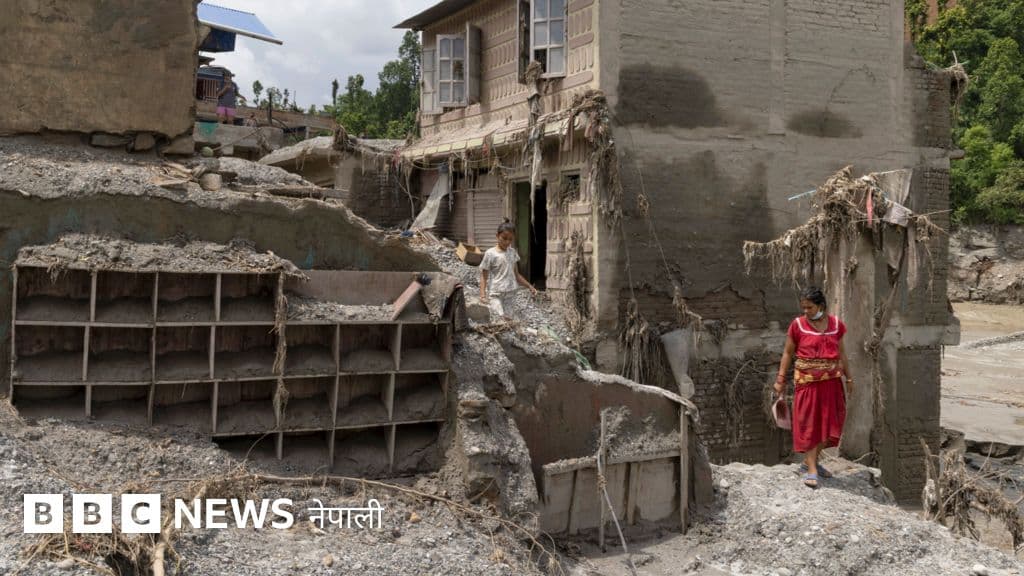
Thousands of private houses have been destroyed in four districts of Nepal due to the severe flood of Bhotekoshi, which is said to have been caused by an avalanche in the Nepal-China border area.
According to the National Disaster Risk Reduction and Management Authority, thousands of displaced people are now kept in various holding centers in Rasuwa, Nuwakot, Dhading and Kathmandu.
During the Bhotekoshi flood, the water, rocks, and mudslides swept away even the concrete houses in a matter of minutes.
Eleven hundred people have been killed and about four thousand people are still missing.
The initial estimate of the Urban Development and Building Department is that 7,500 private houses were damaged in the incident.
According to the deputy director general of the department, Prakash Aryal, among the damaged houses, 1,779 in Rasuwa; 3,977 in Nuwakot; 1551 in Dhading; and 263 in Gorkha.
"Similarly, 53 government buildings have been damaged. Among them, 25 in Rasuwa, 8 in Nuwakot, 17 in Dhading and 3 in Gorkha," said Aryal.
It is said that when those houses were destroyed, the damage was worth billions of rupees. The exact details are yet to come.
Nepal's biggest disaster before this was the 2072 earthquake.
At that time, more than five lakh houses were completely damaged and two and a half lakh were partially damaged.
Even then Rasuwa, Nuwakot and Dhading were in the forefront of the list of the most affected districts.
But Sushil Gyawali, the former head of the National Reconstruction Authority, which was formed at that time, said that the damage caused to private residences by these two disasters was completely different.
"The most important thing is that even though the house was destroyed by the earthquake in the previous disaster, people could build a new one using the old materials of the destroyed house. Now, the house and the ground have been washed away," Gyawali said.
"The main challenge is to identify the land in a suitable safe place and relocate the settlement. Due to the economic-social-cultural relationship of the people, they should be relocated as close as possible. But preserving the life cycle should be the first priority," he said.
He suggested to take the subject of reconstruction in an integrated manner and to move forward by remembering the past experience.
"It would be better to follow the model of integrated settlement development in nearby suitable places for example in Vidur Valley where all kinds of infrastructure are available and where structures like special economic zone for industrial development can also be developed."
In the past, during the earthquake, the government provided a grant of Rs 3 lakh in three installments for the reconstruction of private housing.
BBC News Nepali is also on YouTube. Click here to subscribe to our channel and watch published videos. You can also find our content on Facebook, Instagram and Twitter. And you can listen to the program of BBC Nepali Service at nine o'clock in the evening on the radio from Monday to Friday.