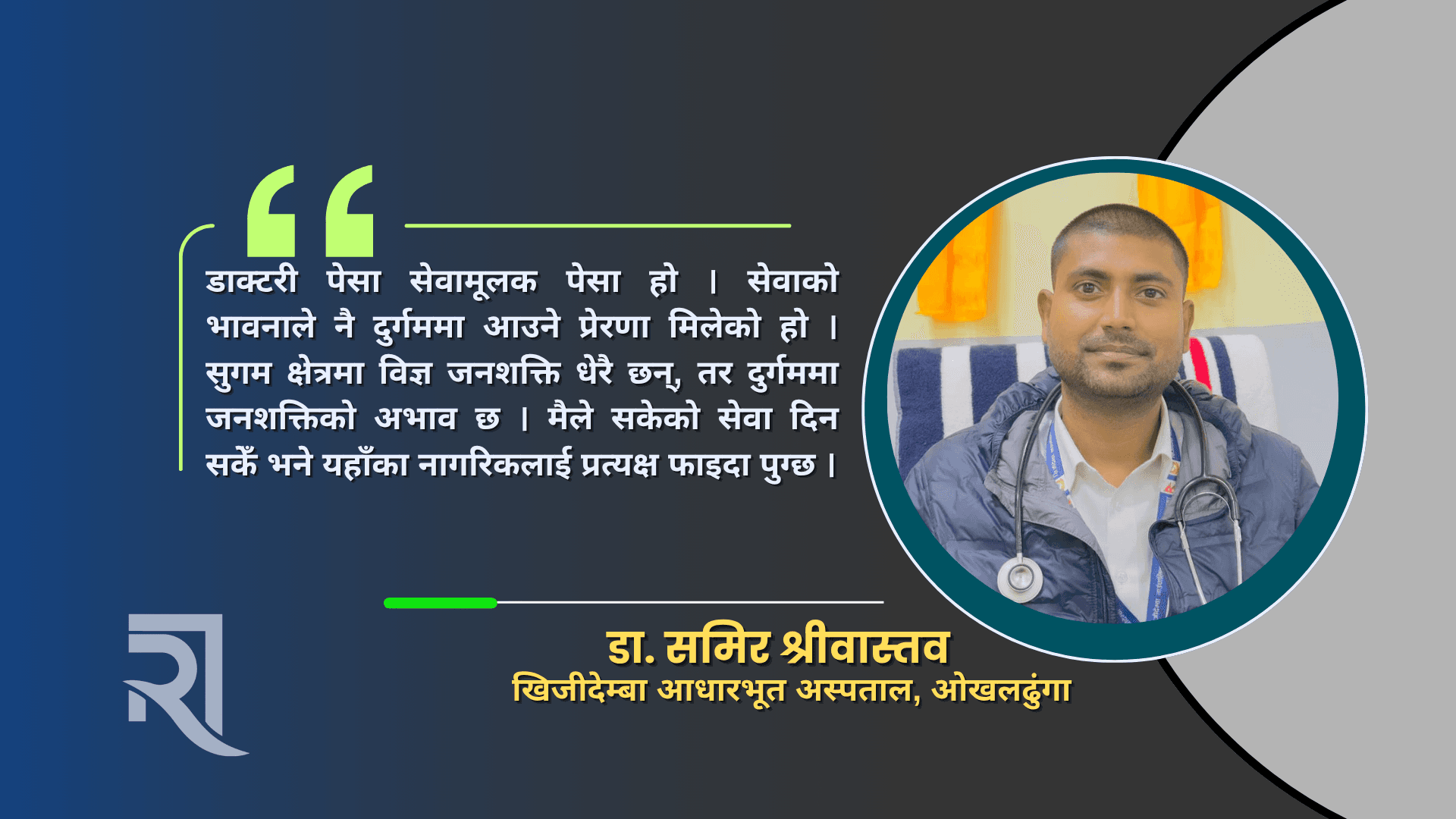
Providing healthcare in remote areas is a challenging task in itself. In the midst of limited resources, difficult geography and lack of specialist manpower, health workers have to handle not only the treatment of patients, but also the responsibility of hospital management. However, taking this challenge as an opportunity, medical Dr. is serving at Khizidemba Basic Hospital. Sameer Srivastava.
Dr. completed his MBBS studies from Bangladesh. Srivastava also started his medical journey from Bangladesh. After serving there for some time, he returned to Nepal. After coming to Nepal, he provided health services in Godavari Municipality of Lalitpur and then went to Khizidemba Basic Hospital in Okhaldhunga.
The decision to come to Khizidemba was not easy for him. He says that after hearing about the remote geography and the difficult road, he even returned from the road. However, he finally decided to serve in that remote place. For about 10 months now, he has been active in improving hospital services and management along with treating patients in Khizidemba. Since the service is good, patients from the nearby district Ramechhap come here to get the service.
He is focused on the work of cleaning and management of the hospital, availability of medicines, expansion of services and delivery of health services according to the expectations of the patients. The experience, challenges and possibilities of working as a doctor in a remote area' about Jitendra Thapa, a medical officer (head of office) working at Khidemba Basic Hospital located in Khizidemba Rural Municipality-5, Khizifalate. Edited excerpt from conversation with Srivastava:
How was the situation before you came to Khizidemba Basic Hospital? What has changed in the face of the hospital since you came?
thank you I have been here for about 10 months. The hospital was already up and running. The doctors and health workers who worked before me worked according to their abilities.
But according to time, changes in services and facilities are also necessary. We have proceeded with the work on what more services can be added according to the current needs and expectations of the customers. We have moved forward from the old practice and tried to provide better health services to the clients.
Now the services from OPD to IPD are operational in the hospital. Services related to gynecology and obstetrics, birthing, MCH, vaccination and nutritional services are in operation. We are also preparing to gradually start safe abortion services up to 12 weeks.
Khizidemba is known as a remote area. Coming from an accessible area, what is the reason why you chose a remote place?
Doctor profession is a service profession. The spirit of service is the motivation to come to the remote. Sugam area has many services and facilities and expert manpower. There are more expert people than us. But there is a shortage of manpower in remote areas. If I can provide my best service, the citizens here will benefit directly.
I am also confident that I can use my skills in treating patients, counseling them and their satisfaction. "I can do it, if we don't do it, who will do it" also inspired me to come here.
On the other hand, he also thought that he should contribute something for his country. We cannot contribute by going to the political field, but as health workers, we can contribute to the country by making health services better. Citizens have the right to health services. I was inspired by the thought that if we are healthcare workers, who will provide that service without providing it.
What changes have you made in the hospital as the head of the office in the 10 months since you came here?
After coming as the head of the office, we have modified many things as needed. We have emphasized on waste management, sanitation and overall management of the hospital.
We have tried to organize various sections and departments of the hospital. We have organized the management and stock system of necessary materials in IPD, OPD, dressing and other departments.
These things may seem small, but they are very important to running a hospital effectively. For example, if the dressing room does not have necessary scissors, gauze, etc., after the patient comes, the items have to be brought from another room. Therefore, we have made arrangements to make available the required material in the room.
We have also paid attention to things from staff mobilization to awareness in the hospital. Earlier, there were services and facilities, but the present needs, expectations of the patients and the necessary preparations to fulfill them have improved.
You also worked in remote areas of Bangladesh before returning to Nepal. How easy was that experience to work in Khizidemba?
I got an opportunity to work in a remote area of Bangladesh on behalf of Nepal through an NGO in Norway. While working there, I gained the experience of working closely with the community and the challenges of delivering health services to remote areas.
Therefore, even after returning to Nepal, there was a desire to work in remote areas. After serving for some time in Godavari Municipality of Lalitpur, I got an opportunity to come to Khizidemba. I am working with a close understanding of the geography and health care situation here.
What kind of services can patients get at Khizidemba Basic Hospital now?
Currently, various types of health services are available from the hospital. OPD, IPD, women and maternity services, birthing, MCH, vaccination and nutritional services as well as Ayurveda services are also in operation.
Similarly, X-ray, pregnancy ultrasound, ECG, whole body examination, lab services and eye services are also available. These services are provided 24 hours a day, seven days a week.
Mental health medicines are also provided free of charge throughout the municipality. In order to make the hospital comfortable for all citizens, the hospital has also been made completely disabled friendly.
From the external board of the hospital, the interior decoration, nursing station, furniture, etc. are also changing. How was such improvement possible in 10 months?
Khijidemba rural municipality has great support in this. Village head, deputy head, village head administrative officer and people's representatives deserve thanks. We first prepared a blueprint of how to make the hospital. We identified what is needed in the hospital and presented it to the local level. Their positive support was received. After that, we added necessary furniture, drug management racks and trolleys to the nursing station, IPD, and OPD wards.
As the number of patients increased, it was necessary to add chairs and other necessary materials. The material which was sufficient before became insufficient due to the increase in the number of patients, so we have been supplementing it according to the need.
Which health problems are more common in patients who come here?
Due to the geography and cold weather here, problems such as tonsillitis, fever and cold are more common in children. Cases of accidents also occur due to geographical conditions. There are trauma patients who have broken legs and various injuries after falling from the mountain.
Similarly, patients come with problems such as viral and bacterial infections, typhoid, acute gastroenteritis, nausea, stomach ache and ringworm. Patients with mental health problems also visit the hospital. Most services at the hospital are free. The municipality has also provided free services for mental health patients.
Is there enough medicine provided by the government of Nepal for free?
There are 98 types of government medicines in sufficient quantity. It is also fulfilled by the rural municipality. Apart from that, the rural municipality has been purchasing more medicines from its own internal resources and distributing them free of charge. Apart from the 98 types in the government list, we have been providing about 23 types of other medicines free of cost.
What is the situation of safe and unsafe abortion in Khizidemba? What kind of patients have come?
Recently, I have not directly met a patient of unsafe abortion. Therefore, it cannot be confirmed that such a situation exists. But there are those who come for counseling for safe abortion. Some also come with family members. We check the patient's health condition and provide appropriate counseling according to their needs and health condition.
Now, what needs to be done by the local, state and federal governments to provide better health services to the citizens here?
Currently, there is no great shortage in the level of service we are providing here. But some services need to be added to make the hospital more efficient. The issue of operations service operation is especially important. For this, the necessary health workers and OT staff should be managed. It is also necessary to consult on the appropriateness of operation of surgery services in view of the geographical situation here.
Manpower addition is also being done. We are preparing to bring more doctors and start dental services. Similarly, it is necessary to connect various specialist services. Especially MDGP is very effective for citizens of remote areas if there is an arrangement of doctors.
If the central government provides MDGP doctors in municipal level hospitals, it can become a situation where different types of services can be provided from the same hospital. This will greatly benefit the customers here.
How do you see providing so many services in remote areas?
It is not enough to have a hospital in a remote area, patients should also be able to get the necessary services at their own place. If it is possible to reduce the need to go far even for general examination or treatment, it will bring great relief to the community.
Therefore, it is our endeavor to expand the services by making maximum use of the available resources and make the hospital a health institution trusted by citizens. There is a need to add more services and we are working continuously for that.
Finally, what do you want to say to the citizens of Khizidemba?
Do not hide health problems. Come to the hospital on time and get the necessary consultation. The aim of us health workers is to provide quality and effective health services to the citizens here. Although working in remote areas is challenging, our main aim is to provide good service to our customers.