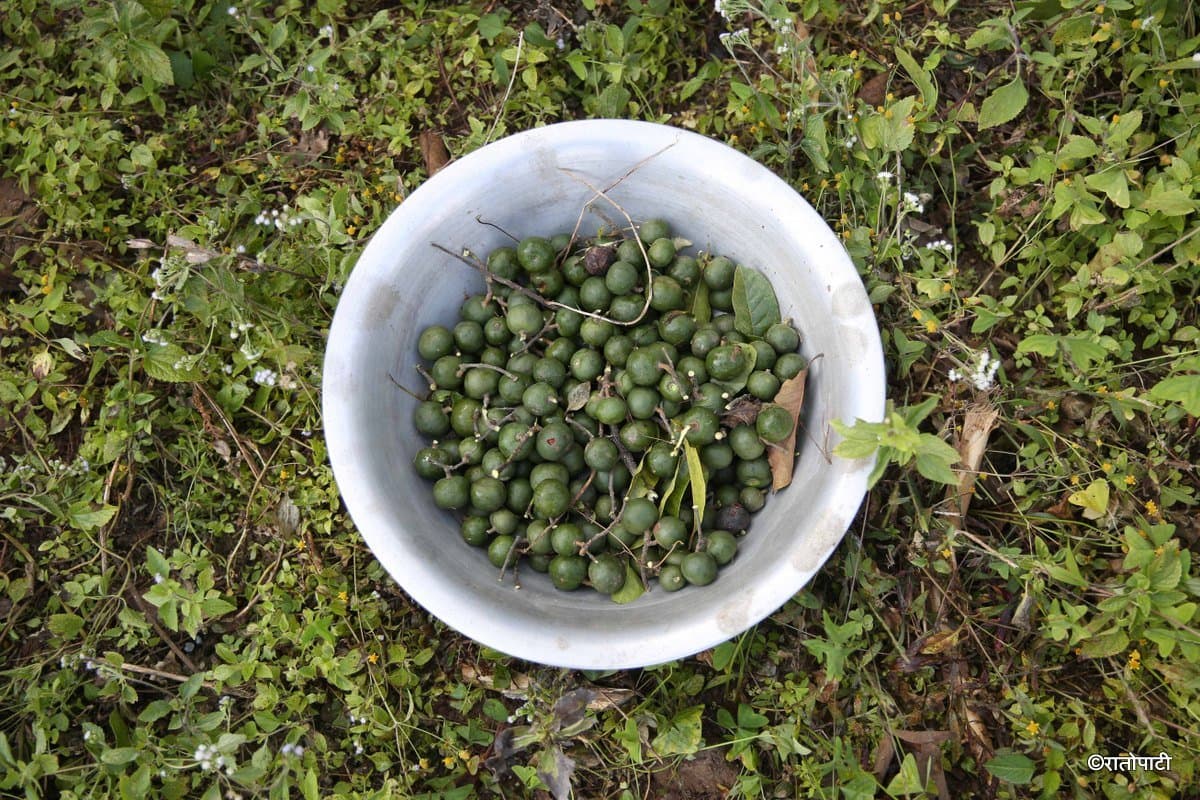
Elam. When it is difficult to get good income from traditional farming, a farmer of Ilam Mangsebung has made rudraksha farming a new way of income. Mangsebung rural municipality-2 Kabrabote farmer Prithiman Zavegu has been cultivating Rudraksh for the past 10 years. Javegu, who has planted rudrashra on the arable land, has been earning two lakhs of rupees annually.
He has planted 300 Rudraksh plants in 18 plantations. He said that in the year 2073, Rudraksh was planted by buying seedlings from Sankhuwasabha at the rate of Rs. 200 per gota. He said that after four years, all the plants started producing.
"In 2073, I brought 300 rudraksha plants from Kuswabensi of Sankhuwasabha at the rate of Rs. 200 per bushel and planted them in arable fields," he said, "production started after four years. Two lakh rupees are being earned every year since 2077.
Javegu said that Rudraksh does not require much effort like other crops, so all the income is saved. He said that even though it costs money to buy plants, create pits, manage fertilizers and irrigation, once the plants grow, there is no cost. He says that other food crops require annual investment and labor, but after planting Rudraksh once, you can get income for a long time.
There is no market concern for the sale of Rudraksh produced by Jawegoo. He said that the traders of Sankhuwasabha used to make contracts with the plant itself on the condition of paying two lakh rupees annually. I don't have to do anything to sell Rudraksh. They will come after production. Dana looks at herself. "You choose as many mouthpieces as you like," he said, "you pay according to the contract."
Zawegu, who has been cultivating food crops such as corn and millet traditionally in the past, said that relatively good income can be obtained from rudraksha with less effort. Now the income from Rudraksh has directly helped him in his household expenses. "Earlier, when working hard, it was difficult to make ends meet from food crops," he said.
He said that he is planning to expand the cultivation of Rudraksh in the future as he started getting regular income from Rudraksh cultivation. Jawoogoo, who is planning to plant rudraksh on new land next year, has been informing other farmers of the village about rudraksh cultivation.
After Zawegu started commercial rudraksh cultivation for the first time in Mangsebung, other farmers have also started planting rudraksh in small areas for testing. According to Javegu, Rudraksh cultivation can be commercialized if attention is paid to technical support, quality plants and market management at the local level.
Javegu says that if quality and rare grains are produced from Rudraksh, a large sum of money can be obtained at once. "The price of all grains is not the same," he said.
Its 'mouth' is determined on the basis of the natural lines or lines seen in the grains of Rudraksha. The price of rudraksha grains is determined differently according to mouth. Generally eight to 29 mukha grains are considered 'mukhdar' rudraksha. According to traders, the more the number of mouths of Rudraksha, the more rare and valuable it is considered to be, so its market is accordingly high.
Since Rudraksha grains are used for religious and cultural purposes as well as making garlands, ornaments and various materials, it is in demand in the market. Due to its religious and spiritual significance, the demand for Rudraksha is high not only in the country but also abroad, according to businessmen.
Rudraksh can be cultivated at an altitude of about 1,800 meters above sea level. Clay, sandy and sunny land is considered suitable for this. It is considered suitable to plant its plants during the rainy season, i.e. from June to October, with a spacing of 10 meters. This cashew tree, which can be cultivated in the Terai to mid-hill areas, continues to bear fruit for up to fifty years after it begins to bear fruit.
National News Committee is the official news organization of Nepal.