
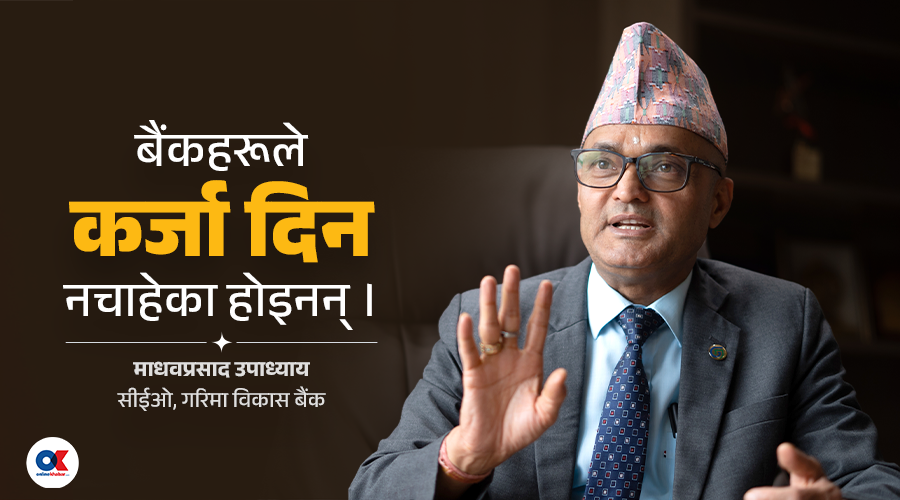
Madhav Prasad Upadhyay has been working as the Chief Executive Officer (CEO) of Garima Bikas Bank for 2 and a half years. Upadhyay, who started his banking career from Garima, managed to reach the leadership level of the bank in about two decades. Upadhyay, who has a master's degree in business administration, joined Garima Bikas Bank from the official level.
His banking journey started with the establishment of the bank in 2007. According to him, the demand for loans in the financial sector has decreased due to the increase in the migration of Nepal's young manpower to foreign countries and the decrease in domestic production and consumption. Stating that the foundation has been prepared to transform Garima Bikas Bank into a commercial bank if suitable opportunities are available, he said that there is a plan to make Garima the first choice bank of the customers. Upadhyay says that banks and financial institutions have recently developed a practice of providing services according to the needs of the customers, instead of selling their products by force (push sale). Bhuvan Poudel's conversation with CEO Upadhyay about the current situation of the overall financial sector and future plans of Garima Bikas Bank for online news:
Now there is more liquidity in the financial system, the demand for credit also seems weak. In particular, the demand for loans has decreased or have the bankers controlled the loans?
It is not that banks do not want to give loans. Banks and financial institutions are doing a lot of advertising by bringing various loan extension schemes. Banks are asking customers to take loans through media, social networks and their own means. Therefore, it cannot be said that the bank does not want to give loans.
The change in the consumption patterns of our society has also had an impact on the lack of demand for loans. A large number of young people have left due to foreign employment. As the youth leave, the pattern of consumption has also changed. It is the young people who spend on new clothes, delicious food, travel and other areas. However, that age group has now gone abroad for employment. Because of that, the expected improvement in loan demand did not come.
Remittances in Nepal have reached billions of rupees and a large part of it has been used for consumption. However, no country in the world has become rich by buying goods, it has become rich by producing and selling them. We should develop industries and businesses that prioritize exports and replace imports. An environment should be created in which people engage in economic activities. If that happens, economic activity will increase and its impact will also affect the demand for credit. People of entrepreneurial age are now abroad. They have earned abroad and sent remittances. If he was in Nepal, he would have done business by taking a loan. They could increase domestic production and also contribute to exports. The money they invest is accumulated as savings in the banking system. Therefore, liquidity has increased but demand for credit is weak. While investing in startups, banks hesitate to give loans without collateral because there is no certainty that the loan will be raised even if the enterprise fails. Therefore, banks have no problem in providing unsecured loans if the state mechanism has developed a mechanism to prevent loan defaults.
It is not that banks do not want to give loans. If a bank gives a loan to a project, the project fails and the money is not raised, the regulator questions the bank's decision. There may be investigations and lawsuits against the decision maker. In such a situation, bank decision-makers do not want to take risks by giving loans to unsecured projects. Therefore, there are legal and institutional obstacles in the credit system.
He said that now banks are trying to give loans. However, banks are not going door-to-door looking for customers like in the past, right?
At present, the banks have not requested the customer to take a loan. Lately, Nepal Rastra Bank's credit policies are stricter than in the past. In the past, loans were misused and defaults increased. After that, it was necessary to see where the loan went, how it was used and whether it was invested for the approved purpose or not. Therefore, now rather than controlling the credit, lending has been disciplined. Although the supply of liquidity is sufficient, it also helps to weaken the credit demand.
In the past, there was a practice of giving unsecured loans on collective guarantees in microfinance. In addition to that, the National Bank also made subsidized loans mandatory in every branch. It became 'push marketing' in the market.
A single person's ability to repay a loan was 5 lakh rupees, but when many organizations gave him a loan, his loan increased to 50 lakh rupees. With easy access to money, consumption also increased. The problem of financial literacy of the customer is also added. It is necessary to be disciplined to use the loan for the purpose for which you have taken it.
In 2072, the central bank increased the capital of banks up to 4 times. The added investment in the bank also seeks returns. Dividends should be paid to investors. At that time, some legal provisions of lending were also easier than now.
Later, limits were set in personal loans, real estate and other areas. Due to insufficient use of credit in productive work, there was a problem in repaying the loan and the NPL increased. Then the banking system corrected it and started paying more attention to loan selection and asset quality. In addition, the bank has worked on the concept of providing products or services only after identifying the customer's needs. Earlier, when a customer opened an account, it was a practice to sell multiple services including mobile banking, debit card, credit card etc. at once. Now, if the customer already has a credit card, the question arises, why should they give another card? You have to assess what the customer really needs. It is moving the banking system from 'push sales to need-based sales'.
How do you view the allegation that there is now a problem in the financial sector because banks are emphasizing on credit investments that encourage consumption rather than how they contribute to the economy?
To some extent that may be true. Banks naturally go where there is marginal gain. There was such an opportunity in consumer loans. However, it is not right to see the home loan as a consumption loan. When building a house, money goes to many areas including rods, cement, labor. It keeps the economy running. But there is a need for more attention of the banking system in the areas of increasing entrepreneurs, industry and domestic production.
The bank also did business. Investors should get the return of the capital invested in the bank. But it is not enough to just see that 'the bank earned so many billions'. On the basis of how much capital has been earned, how much capital has been invested, the return on investment, earnings per share and other indicators should also be looked at. The bank must earn profit. The bank does not have to go into losses. Bank is a trust based institution. Customers have deposited not only money but also trust in the bank. When trust is broken, both deposits and loans in the bank are affected.
The banking sector is highly regulated. Development banks cannot take more than 4.6 percent spread and commercial banks have a limit of 4 percent. Competition has brought the spread down even further. The current spread of Garima Bikas Bank is around 4.034 percent. Therefore, it is not true that banks are making exaggerated profits.
Garima has given 5% dividend two years ago, 10% last year and now 20%. Averaging the total of 35 percent over three years does not even reach 12 percent annually. Therefore, it is not appropriate to say that the bank has earned a lot just by looking at the dividend of one year.
What is the reason for the liquidity and interest rates of the banking sector to fluctuate a lot?
Our banking market is not stable. Sometimes there is a lot of liquidity, sometimes there is a shortage. The interest rate also changes accordingly. All of us who work in the banking sector must be disciplined. Care should also be taken to ensure that there is no unnatural competition in interest rates. The National Bank is regulating through the interest rate corridor. However, the matter to be determined by the market should be left to the market. Now the interest rate is low. The government needs to rebuild and develop infrastructure. At such a time, if a sufficient amount of national debt can be raised and spent on development, it can also help in managing the excess liquidity of the banking system. If large hydropower, industry and infrastructure projects start to be built, the current liquidity may not seem to be too much.
In order to maintain stability in liquidity and abnormal interest rate fluctuations, the interest rate was fixed by the banks as well. It is also called carteling, which is wrong. It was agreed that we should work within a standard and maintain stability in the market.
The banking sector is a highly regulated sector. When there is a strong regulator like the National Bank, there is no situation where organizations can only work on their own terms. However, there should be room for competition in the open market. Talking about Garima Bikas Bank, now our CD ratio is around 84 percent, which is in the comfort zone for us in terms of the market. However, the average loan-to-deposit ratio of the financial sector is 71.27 percent.
Banks are complaining that there has been 'over regulation' in the banking sector, what is the reality of this?
I don't think the banking sector is overly regulated. Banking is a very sensitive area. The regulator will make rules by looking at the overall situation of the country and international practice. However, there is room for improvement in some systems. For example, as soon as the loan exceeds one year, there is a provision to classify it as a bad loan and make a 100% provision. Then you have to go to the recovery process. We have been discussing with Rashtra Bank whether the deadline for classification of loans can be extended. It takes time to earn money by running a business. After taking the loan, the borrower needs some time to learn the business, operate it and convert it into returns. For example, someone has assets of 10 crores and starts a business with a loan of 2 crores. Even if the business does not perform as expected in a year or two, his net worth can be strong. However, if there is a bad loan as soon as one year is completed, there is less legal space to give him more opportunities. If a borrower with adequate collateral and net worth can be given 'breeding space' for some time, he may get an opportunity to improve the business.
It is said that the tendency to take loans to repay loans has caused problems in the financial system, what is the reality?
Doing business with a loan can sometimes cause obstacles. The project may fail or there may be problems in the market. If the net worth of the borrower is strong and there is potential in his business, there should be an arrangement to give him an opportunity by adding some time. However, the situation of taking loans to repay loans continuously by misusing loans is not sustainable in the long run. If there is a problem once, there is no place to come back again is not suitable.
It is said that the pressure on Garima also increased when Muktinath Bikas Bank, which started its business from the same district, started the race to become a commercial bank, right?
Garima Bikas Bank's competition is with its own past rather than with others. How much better was the business today than yesterday? How much has the property quality improved? How happy were the employees? What is the state of customer satisfaction? How good is the organization considered by the regulator and the society? We are competing with ourselves on this basis. You know the journey of your own organization better than the journey of other organizations. Therefore, we are focused on the past and future goals of the organization.
Is Garima Bikas Bank's goal to be upgraded to a commercial bank?
It is natural to look for chronological growth. Garima Bikas Bank also dreams of becoming a good commercial bank. We started with the walling of Syangja in 2064. We came to Pokhara in 2067. Then we came to Kathmandu as a national level development bank. However, it is not possible to say that we will become a commercial bank within these days. It should be evaluated whether the existing legal system, capital and other standards of the National Bank can be met or not. Our priority is to make the current organization strong and reliable. If the opportunity arises in the future, it is to prepare the basis to be ready to become a commercial bank.
You have also kept the agenda of merger open. What is its purpose?
We have been putting the merger agenda in the general assembly for 10 years. It does not mean to merge with any organization immediately. It is a message that the opportunity is open if our purpose, spirit and approach to work match with any bank and financial institution in the country. Therefore, we have not closed the door of merger. There may also be a possibility of increasing the capital base through merger and becoming a commercial bank in the future. However, there is no definite idea of which organization to merge with.
Garima Bikas Bank is the first Bikas Bank to launch virtual credit card in digital banking, lending in payment ecosystem has also started?
The bank has a separate digital banking department. It studies new products and technologies in the market. In addition, it also suggests to carry out such schemes as it deems appropriate. Virtual credit card is also an attempt of the same. At the same time, seeing the possibility of virtual credit card, we have brought it as a test. Commercial banks had already put it into use. We were the first development bank. Being the first is also a coincidence. Now it is in the test phase. A virtual credit card is a combination of credit facility and digital payment system.
Similarly, efforts are being made for digital loan schemes for phone loans and various platforms have also been created. Even from the National Bank, there is a provision that loans can be given through digital means up to a certain limit. Accordingly, some banks and financial institutions have already started. We are also studying it. It should be seen how to reconcile legal and technical aspects. Only then can it be implemented.
Only one organization cannot be digital. A lot of data including income, expenses, assets, liabilities, social and economic behavior of a person should be added to the system. If all these data are integrated and available automatically, credit scoring of each individual can be done. After that, digital lending is possible. By integrating data including national identity card, citizen app and tax system, a person's income, expenses, assets, tax payment and liability details can be added to one system, then one can go from mortgage-based loans to credit-based loans. For this, the state should look at it as a whole. Only one organization or one sector does not become digital. A data system should be developed at the national level.
Banks are investing heavily in digital technology. However, cyber risks are also increasing. It seems that there is not enough preparation in this aspect, what do you say?
We have invested in adopting technology. However, it seems that more work needs to be done in managing the risks brought by technology. For example, if the mobile phone of a person using mobile banking is hacked and millions of rupees are transferred through various transactions, the account can be blocked when the customer informs the bank. However, the mechanism to stop the transferred money immediately is not enough. As technology advances, so does risk. Therefore, we should not only accept the change, but also develop a system to control the risk it brings. It is difficult to solve such problems unless the customer himself is aware. Incidents such as giving password or OTP to others, falling into phishing, and sending money claiming to have won a lottery are happening. There is a weakness of the customer. Sometimes even educated people are trapped due to greed. Banks are conducting financial literacy programs, but the first requirement is for the customer to be self-aware.
The bank can handle reporting, legal processes and money tracing. However, when the customer has given the confidential details to others, it is difficult to get the money back after the money is gone. In many cases middlemen or porters are used. An account is opened in the name of a person by showing greed to give him some money. The money in that account will be taken by another person. In such cases, in some cases, the person who opened the account himself may not understand the nature of the actual crime. Especially young or inexperienced people are used. Therefore, when opening an account, customer awareness, transaction monitoring and a system for immediate identification of suspicious transactions are necessary.
Now money can be transferred from one bank to another within minutes. By the time the customer knows and reports to the bank, the money may have moved to other accounts. Even if the payment is stopped for a second, the customer complains, but it is not known until the reporting is done to trace the misplaced money. Therefore, there is a need for an immediate exchange of information and a money blocking mechanism between the National Bank, security agencies, banks and financial institutions and all related agencies.
What is the upcoming new plan of Garima Bikas Bank?
The bank's immediate plan is to make the institution stronger and more reliable. The goal is to be stronger in terms of property quality and business growth. We also have to reduce bad loans. Now our NPL is around 4.77 percent. There is a plan to improve it. Human resource development is also a continuous process. Employees should be continuously taught and sharpened. We want to make ourselves a 'resilient bank'. Our goal is to become an organization that can face changes and risks in the future.
The plan is to be established as a bank that accepts change and is ready for the future. It is not known when events like floods, earthquakes, and covids will occur. Therefore, technology, human resources and working systems should all be made capable of facing future challenges. Development is the process of continuously improving what is there today. In addition to the strength of the organization, winning the trust of the customers is the most important thing. Whether it is a commercial bank or a development bank is a classification made by the state. Our effort is to become a good bank, not just a big one. We are working with the goal of becoming better and bigger.
What is your message to Garima Bikas Bank customers?
Currently, Garima Bikas Bank's base rate is the lowest among Bikas Banks. The base rate is 5.22 percent. Therefore, it may be relatively cheaper for the customer to get a loan from Garima Bikas Bank.
Nowadays, customers have many options in the market. There is a situation where you can get services by comparison. Therefore, I request the customer to use our service as well.
Photos: Aryan Dhimal/Online News