30 October, Surkhet. The construction of the Sisol-Lysicap road section under the Veri Corridor, which is seen as an important plan to connect Upper Dolpa with the national road network, has started.
The rural municipality informed that the construction of the road was started in accordance with the local original culture and tradition in the presence of people's representatives of Dolpobuddha Rural Municipality, representatives of the Nepali Army, local communities and village lamas.
The Bheri Corridor is considered as a road project of national importance, starting from the Nepal-India border area at Jamunah in Banke, passing through Surkhet, Salyan, Jajarkot and Rukum West, crossing Dunai, Dho and Tinje in Dolpa and reaching Marimla in the Nepal-China border area. This road, which is about 317 kilometers long, is expected to expand access to India in the south and China in the north.
Challenges of road construction in difficult terrain
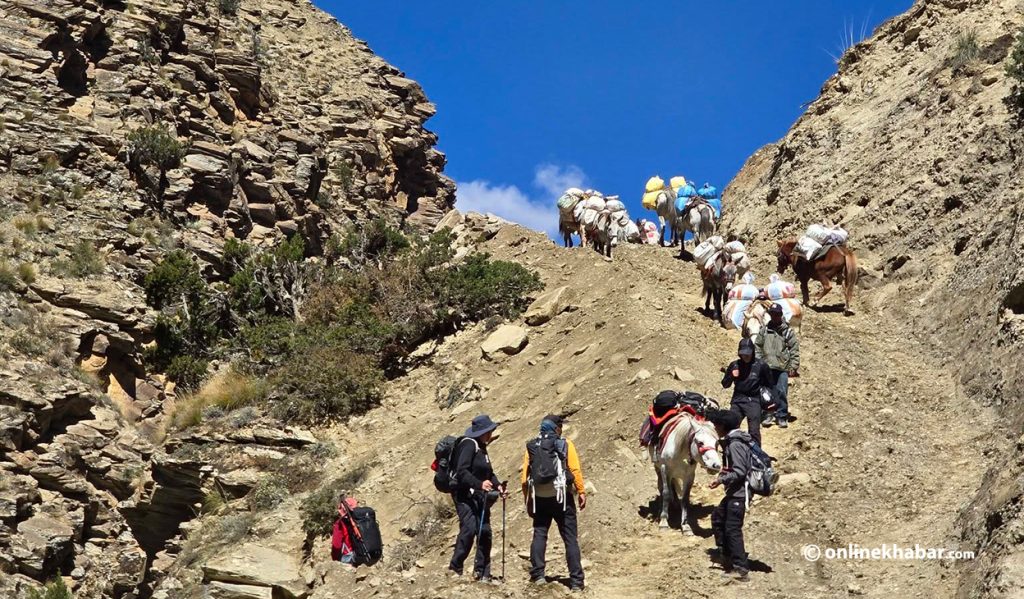
Due to the difficult topography of upper Dolpa, steep hills and hard rocks, road construction has not been able to accelerate for a long time. Earlier, there was an attempt to open the road section through a private construction company, but due to geographical difficulties and construction related problems, the work could not proceed as expected.
In March 2082, the government decided to hand over the construction of the Lasicap-Sisol road section under the Bheri corridor to the Nepali Army. The Army has been given the responsibility to speed up the construction of the road in that section, which is about 33 to 35 km long.
The Nepali Army started the process of establishing a temporary base camp in Dho area of Dolpobuddha Rural Municipality from 17th July 2083 and proceeding with the construction work from Sisol.
Roads can change life in Upper Dolpa
Due to the lack of easy access to the road network, the residents of Upper Dolpa have been facing difficulties in accessing daily consumables, health services, education and markets. There is a situation where the residents of some settlements have to walk for several days even to reach the headquarters.
If the road construction is completed, it is expected that the movement of the local residents will be easy and the time and cost of transporting food and other necessary materials will be reduced. Pemma Dhorche Gurung, Vice President of Dolpobuddha Rural Municipality, said that the road will help to transport patients to health institutions for treatment and expand access to educational opportunities for students.
It is expected that it will be easy to transport the herbs like Yarsagumba, Jatamsi, apples and walnuts produced in upper Dolpa to the market. It is expected that this will help to expand the marketing of local products, employment and income generation opportunities.
Potential for tourism and cross-border trade
Due to its natural beauty, mountainous geography, original culture and historical settlements, Upper Dolpa is an important area from the point of view of tourism. With the expansion of road access to Phoksundo Lake, Dho Valley, Tinje and nearby mountain settlements, the movement of internal and external tourists can be facilitated.
The Veri Corridor is also seen as a potential trade and strategic link between Nepal, India and China. It is expected that if the road access can be extended up to the Marimla border, it will help the movement of the residents of the border area and business activities. However, the mere completion of road construction may not automatically ensure regularization of cross-border trade. For that, the operation of border posts, necessary infrastructure and coordination between the two countries will also be important.
Collaboration is necessary to achieve a common dream
Dolpobuddha Rural Municipality has expressed its gratitude to all those who directly and indirectly helped to make this historic initiative of road construction possible. The rural municipality explained the road not only as a means of transportation but also as a common dream connected with easy access, prosperity and bright future of Upper Dolpa.
But difficult geographical conditions, transportation of construction materials and equipment, provision of sufficient budget and timely completion of work are still challenges. Therefore, effective coordination between the federal government, the Nepali Army, the local level, the relevant project office and the local community is necessary to continue the construction work.
Residents of Upper Dolpa, who have been waiting for road access for years, have gained hope as the construction of the Sisol-Lasicap section of the Veri Corridor has picked up speed. Now the main challenge will be to convert the start of construction into road access in practice and complete the quality work within the stipulated time.