
25 October, Kathmandu. Nepal's infrastructure sector has suffered the third major blow in the last one and a half months.
Roads, bridges and hydropower projects along the hilly side of the river were hit by continuous floods and the country had to bear losses worth billions of rupees within a month and a half.
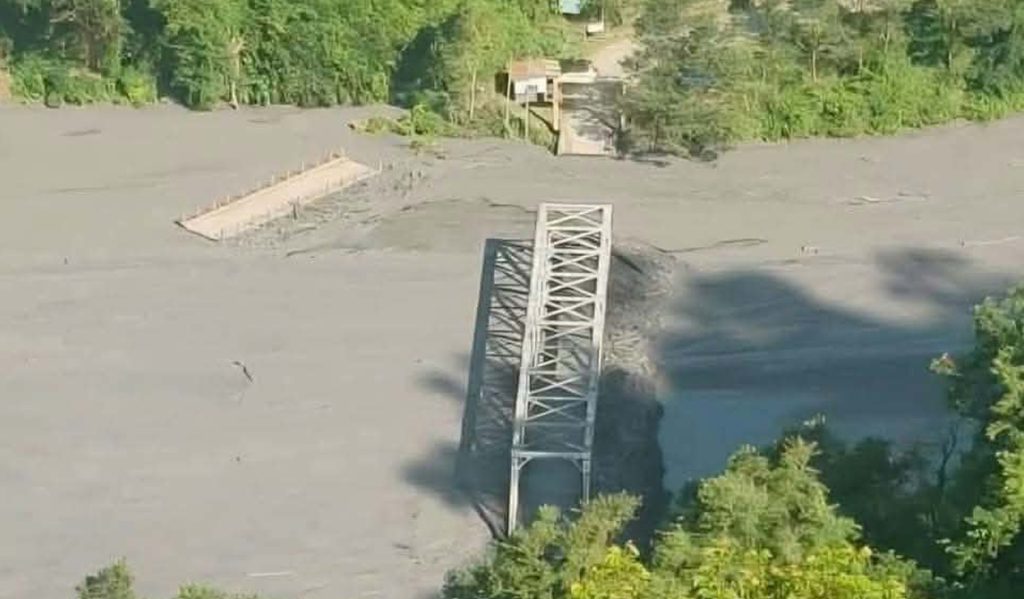
According to the National Disaster Risk Reduction and Management Authority, a large landslide occurred between Lokpa and Chumling in Gorkha Chumanubri rural municipality-6 on Sunday, and the Budhigandaki river, which flows through the same place, caused a huge flood.
According to the latest data, the flood swept away the old suspension bridge connecting Sirdiwas located in Chumanubri Rural Municipality-3 Nyakchet. In the same place, one house was washed away and one house was flooded.
The suspension bridge connecting Kerauza from Macchikhola in Gorkha Dharche Rural Municipality-5 has also been swept away by the flood. Times Urja Pvt Ltd under construction in Salleri of the same rural municipality and 7/8 houses in the vicinity have been washed away.
Similarly, one part of the concrete bridge connecting Dhading from Gorkha Arughat in Nayapul, Arughat Rural Municipality-9, has been washed away and damaged. 20/22 houses have been damaged due to flooding in the lower settlement of Machikhola in the same rural municipality.
The flood swept away the steel bridge in Soti connecting Arughat rural municipality wards 2 and 3. It has been reported that the camp area and some construction equipment of the 341 MW Budhigandaki hydroelectric project were swept away by the flood. The flood damaged two telephone towers and 50 electricity poles on the communication side, according to the authority.
On the other hand, the authority said that the team of Road Department and Local Infrastructure Development Department has been deployed today for road operation and Belybridge Feasibility Study.
According to the road department, traffic has been completely blocked at the same place due to the Soti river bridge being completely washed away. On the bridge at Arughat, 22 meters of RCC has flowed. The technical team is studying the possibility of keeping the belly here.
Earlier, the heavy rains and landslides that occurred from 8 to 11 October had caused great damage to BP Highway to Kaligandaki Corridor, Madhyapahari Lokmarg and Beni-Jomsom and Chame-Bensisahar sections.
Among them, the traffic towards Beni-Baglung, Beni-Korla has not yet been fully started. Nepal-China foreign trade is at a standstill due to the lack of traffic in that section. Due to the stoppage of goods imported from China during the festive season, traders have already suffered billions of losses and the state has also had to bear a huge revenue loss.
On the other hand, traffic has been brought into operation by opening only the tracks on the BP highway. Therefore, there is still a risk that this highway will be blocked immediately even with a single rain. After the Rasuwa-Bhotekoshi flood on August 10, Prithvi Highway has become slippery. Landslides occur frequently in various sections of this highway and the highway is blocked.
Due to this, travelers leaving Kathmandu Valley during the festive season have to suffer extreme hardships. The road which was blocked since last Friday in Gajuri, Galaudi of Prithvi Highway has been operational since Sunday evening.
The Nagadhunga-Naubise-Muglin road project said that the road widening work is still going on here, keeping in mind the traffic flow. Earlier, traffic on this highway was stopped for 18 days when the road was flooded.
Rasuwa-Bhotekoshi's wound is continuously hit without drying up
The infrastructure sector has suffered unimaginable losses this year. According to the data presented by Padmakumar Mainali, the secretary of the Ministry of Infrastructure Development, at the Parliamentary Special Committee meeting on the Bhotekoshi-Trishuli disaster last week, it is estimated that the damage to the country's infrastructure due to floods, landslides and climatic disasters this year is equivalent to 2 trillion 27 billion rupees.
It takes a lot of time to rebuild these infrastructures. However, he has informed that it will cost around 63 billion to start the reconstruction work immediately.
Bhotekoshi flood damaged 7,570 private houses and 48 public buildings. After this, the Kaligandaki river has damaged hundreds of houses. The Rasuwa flood washed away most of the Galchi-Rasuwagadhi road section. Out of this, the work of operating the temporary road is ongoing.
Belybridge has been put into operation in Betravati only on Sunday. Along with this, after 47 days, Rasuwa district has been connected with Nuwakot. This bridge connects Uttargaya Rural Municipality-5 of Rasuwa and Bidur Municipality-10 of Nuwakot.
Disaster forcing road and bridge standards to change
Recent floods and landslides have forced the state to rethink existing road and bridge standards. Accordingly, homework has also been started on the design change.
The Ministry of Infrastructure Development has started preparing to change the design code of the bridge by forming a separate unit on disasters. Officials of the Ministry have informed about this in a program organized by the Nepal Infrastructure Journalists Association last week on 'Damage caused by floods and landslides to road infrastructure and future reconstruction'.
Bhimarjun Adhikari, joint secretary of the Ministry of Infrastructure Development, said that due to floods and landslides, road and bridge infrastructures are being damaged worth billions every year.
He said that due to climate change, the nature of floods and their damage is beyond estimation. He said that after the flood of Trishuli River in 2050, such floods did not occur in Nepal, but, within 4/5 years, we are facing floods and subsequent disasters in Sanfebagar, Melamchi, Jomsom-Korla, Mechi Highway, Roshi Khola on BP Highway and now Rasuwa via Bhotekoshi.
He said that the government has not yet set up a separate unit for the possible damage caused by the flood and its reconstruction.
"After 4/5 years of major disasters, we now need to review the design code, now not only water flows in flood, but also a large gegran along with Ledo has caused damage," said the official, "it seems that the upper coastal area has more damage and the lower coastal area is less affected, now it is necessary to change the design code and make the same type of road and bridge design in the upper part."
He also said that there are no two opinions that future infrastructure construction should be climate-sustaining. He emphasized that while building infrastructure, it should be looked at from various angles of design and security in such a way that the climate is uplifting from the very beginning.
It has been mentioned that now the government's investment has to be spent on the reconstruction of the road bridges that were destroyed after the flood disaster rather than on new projects.
"Now we have 100,000 km of roads, but the tarred roads are less," said the official, "while 65,000 km of roads are yet to be tarred, road safety has become a challenge."
Arjunjung Thapa, a member of the National Planning Commission, said that floods and landslides cause damage every year, but there is no separate unit and budget for that.
He said that because Nepal is in the Hindu Kush Himalayan range, such problems will continue to occur. He said that at that time, Nepal did not even have Beilibridge.
"Currently, there are at least 4/5 options to connect Kathmandu and Terai, and there are also some Belybridges. Another concept of Kathmandu-Terai Expressway was introduced 20 years ago for a long-term solution to such a problem, but it has not worked as expected," he said.
Active in economic journalism, Puri writes about tourism and civil aviation.