31 October, Kathmandu. The children who were made homeless by the flood are in deep mental pain. On top of that, the horrifying scenes of people running around, bodies of dead people and destroyed houses seen on social media are increasing their fear even more.
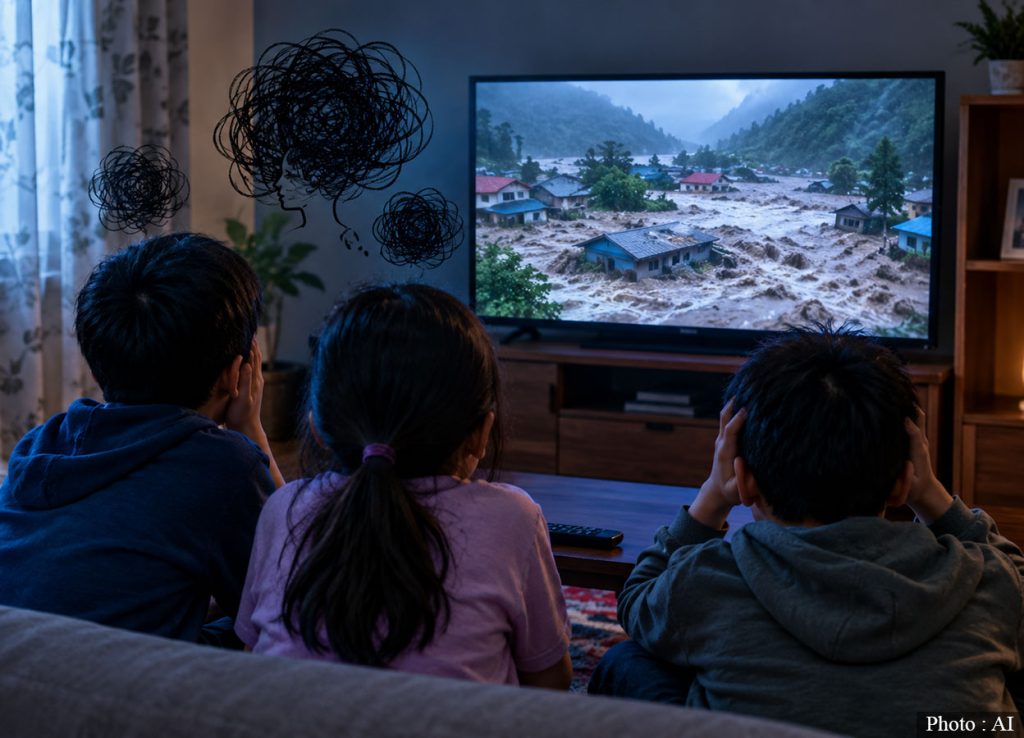
Photos and videos of people who died in the flood are being posted and shared on social media. Even a painful video that has been watched once can be seen again and again due to social network algorithms. Stakeholders have said that this can have a negative impact on the mental health of children and adolescents who are especially directly affected by the disaster.
According to Tara Bhandari, President of Biswas Nepal, while providing psycho-social counseling in the flood-affected areas, even children who have lost all their family members and are alone have been found. For them, the scene of the disaster is not only a video seen on social media, but it is becoming a means to remind them of the pain they have experienced.
The mental health condition of flood-affected women and children is complicated. In the camps run in Nuwakot and Rasuwa, during programs including psycho-social counseling, children who have lost all the members of the maternal household including their mother and father have been found,' said Bhandari.
According to him, the affected children are more stressed because social network algorithms show videos of the same nature over and over again. She said that during the psycho-social counseling, affected people of different age groups reported problems such as fear, body tremors and loss of appetite after watching such scenes.
A single video can evoke pain over and over again
The impact of disaster scenes is not limited to the directly affected children. Other children may also be frightened by repeated exposure to horrific scenes of death, destruction and rescue.
According to Sohan Bhujel, a member of the Child Advisory Committee of Voice of Children, many children and teenagers in temporary shelters in the Bhotekoshi flood-affected area are spending time using mobile phones and watching disaster videos.
Bhujel said that when the children affected by the disaster are in need of a safe environment, adequate care and psychosocial support, the painful scenes seen on the mobile phone can increase their stress.
Raju Ghimire, Deputy Director of Voice of Children and General Secretary of Children as Zone of Peace (CZOP) Nepal, also said that repeated exposure to disaster videos can have a negative impact on children's mental health.
He says that due to such materials, anxiety, feelings of insecurity, sleep problems and frequent recollection of scenes related to the incident can be seen. Therefore, he emphasized that measures should be taken to protect children from accessing such materials and provide them with a safe environment.
Government coordination is needed to control harmful substances
According to experts, effective monitoring and coordination between relevant agencies is necessary to prevent the uncontrolled spread of sensitive scenes related to disasters on social media.
Rajkumar Maharajan, Director and Spokesperson of the National Cyber Security Center of the Information Technology and Digital Governance Office under the Office of the Prime Minister and Council of Ministers, said that effective coordination between government agencies and social media platforms is necessary to control harmful content, misleading information and false information.
"It is too late to coordinate more effectively between relevant government agencies and social media platforms to control harmful online content, misleading information and misinformation," Maharajan said.
According to him, efforts are being made to cooperate with platforms such as Facebook and X (formerly Twitter) to remove harmful content that affects the general public. However, he said, even the deleted content reappears. According to him, more steps should be taken according to the prevailing laws and procedures against those who repeatedly violate the rules.
Maharajan also expressed concern over the increasing trend of spreading false information by using artificial intelligence (AI) to create fake photos, videos and audios that look like the real thing. He said that it is necessary to increase public awareness to face such a challenge.
Stakeholders say that since children are more sensitive to harmful digital content and its impact on their mental and emotional health can last for a long time, there is a need for clear legal provisions, standards and guidelines on online safety.
How to protect children from online risks?
Nepal Telecommunication Authority (NTA) has been emphasizing on parental monitoring and digital security through the 'Child Online Safety Guide, 2076' and various public awareness materials to protect children from online risks.
Parents need to pay attention to their children's use of social media especially during times of disaster. They should be interested in what content they are viewing, how much time they are spending on mobile and how such content has affected their behavior.
The authority suggests that children should be encouraged to manage their screen time, use parental control facilities as needed and report suspicious online activities.
Similarly, instead of abusing children or taking away their mobile phones if they see a scary scene of a disaster, an environment should be created to keep them away from such materials, talk openly about their fears and feelings, and provide psychosocial support as needed.
Although social media is a means of sharing information and receiving rescue and relief information during a disaster, the uncontrolled dissemination of sensitive scenes can create more mental pain. Therefore, it is necessary to give priority to the victims' respect, privacy and children's mental health while publishing disaster-related materials.
Emphasis has also been placed on the development and implementation of an online system where complaints related to abuse of children can be filed. If efforts to control the spread of harmful content, increase parental monitoring and create a child-friendly digital environment are effective, it can help protect children from further mental trauma during disasters.