
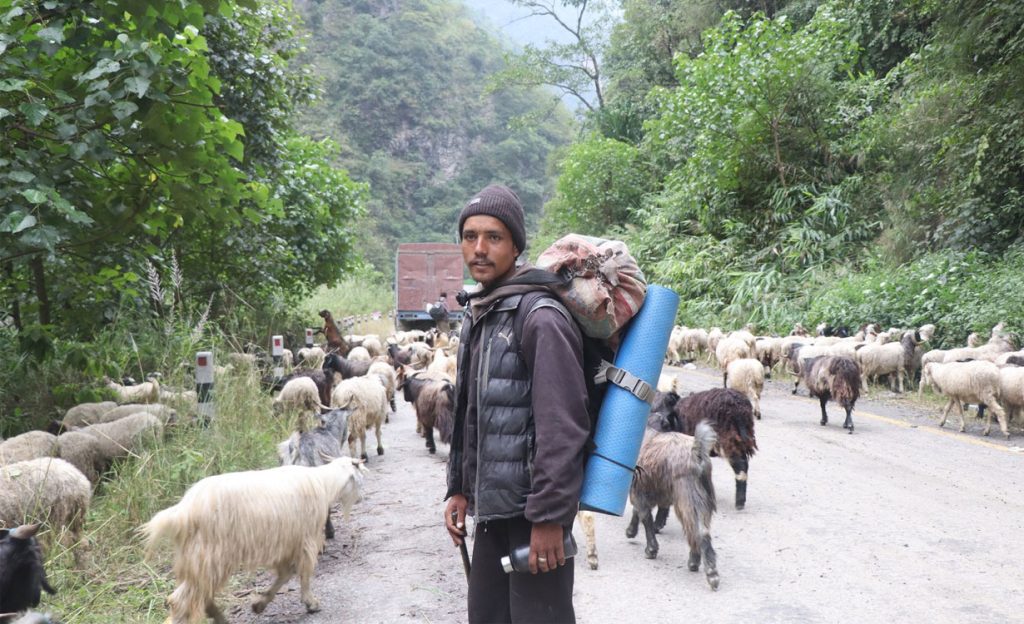
24 October, Myagdi. Four farmers, including Sanjay Bik, who traveled from Mugu to sell lamb for Dasain, arrived at Galeshwar in Myagdi on Friday evening after a 36-day long journey. Due to bad weather, snow and road blockage, they have taken a long time to reach the market and now they are worried about whether they will be able to sell the sheep on time.
BIK's team from Chaya Nath Rara Municipality-6 of Mugu brought two hundred sheep. Among them, 100 were reared at home and 100 were bought from neighbors. They had left home on 18th August last with the intention of selling in Pokhara during Dasain.
"This year, there was a lot of trouble when the Beni-Jomsom road connecting Mustang was blocked due to bad weather", Bik said. We have just arrived in Galeshwar in 36 days after walking from home.
The team has planned to put the sheep in a car from Galeshwar and take it to Pokhara on Saturday. However, as Dasai is approaching, they are worried about the demand in the market and whether they will be able to sell all the sheep they have brought. It is late. Now we are worried whether it will be sold in the market or not," Bik said.
Seven farmers along with Manprasad Rokaya of Kaike Rural Municipality-2 of Dolpa are heading towards Pokhara with seven hundred sheep. They went to Pokhara in Kaski via Ghodepani in Myagdi on Friday. Even though it has been 22 days since they left home, their journey is not over yet.
Having made sheep rearing their main profession, they reach to different cities to sell animals every year targeting the Dasain market. They expect to get good income from the sheep reared by rearing throughout the year. However, this year, floods and bad weather have made the journey more difficult.
Sanjay Budha of Kaike rural municipality-2 Sahartara of Dolpa is also going to Pokhara to sell 160 changras after walking for 25 days. It is not an easy task to chase and bring to the market Chongra raised in areas above 4000 meters above sea level. Farmers have to spend a lot of time and effort to safely bring the animals to their destination by crossing Bhirpakha, Kholsa and narrow roads.
"It is our traditional profession to walk Changra on Bhir, Kholsa and narrow roads and sell them to the market," Budha said.
Farmers suffer when roads are blocked
As Dasai approaches, the lamb market in the Himalayan region has started to decline. However, this year's adverse weather and road blockages have affected both farmers and traders. From Jomsom to Beni, farmers and traders who brought sheep from Dolpa, Jumla and Upper Mustang are busy. They are preparing to go to Pokhara, Kathmandu and other cities to sell animals.
The Myagdi section of the Beni-Jomsom road was blocked by the landslides that occurred after the rains from October 8 to 11. As the road was blocked, the work of transporting sheep by foot was also affected. Some farmers had to walk a long distance while others had to spend days waiting for the road to open. This has increased the time to reach the market as well as the cost.
The lambs brought from Mustang to Galeshwar via Beni-Jomsom road have been placed in trucks and containers and sent to Pokhara, Kathmandu and other cities. However, Lalmani Aryal, Head of Agriculture and Livestock Development Office, Mustang, said that the road from Dolpa to Mustang was covered with snow, so all the farmers there could not bring the lamb to the market.
Due to the closure of Tatopani and Rasuwa crossings, this year Mustang has become the main route to supply sheep meat to big cities. The process of sending the lambs brought through Mustang to Pokhara and Kathmandu for sale continues. In Jomsom, arrangements have been made to permit the export of sheep after health examination.
According to the head of the office, Aryal, 10,000 lambs have been health tested and allowed to export. Last year, 18,000 lambs were exported from Mustang. This year, as the supply was affected by weather and road conditions, it is not certain how many lambs will reach the market compared to last year.
Increase in shipping cost affects sales
Due to the long journey and road blockage, the cost of transporting lamb to the market has increased. Traders say that it is difficult to contact the farmers due to the disruption of road, electricity and communication services in Mustang.
According to Dek Bahadur Chokhal, a businessman of Beni municipality-9, there was a problem in the purchase of lamb since the second week of October in Mustang due to the disruption of road, electricity and communication services. "Because we could not get in touch with the farmer, we could not bring the sheep as promised", he said.
According to traders, one sheep is being bought and sold in Mustang for 32 thousand to 35 thousand rupees according to its size. The price of Changra is about 40 thousand rupees per cow. On arrival in Beni, the price of sheep is around 36,000 and the price of chickens has reached 45,000 rupees.
According to Yam Bahadur Bania of Beni Municipality-9 Toripani, the age and size of the changra also affects the pricing. According to him, five-year-old chickens are considered suitable for meat.
"Even though it is expensive, it is customary to eat the meat of Changra which is grazed in the Himalayan region with herbs on Dasain," he said.
The meat of lamb grown in natural pastures in the Himalayan region is considered as a special dish of Dasain. Therefore, traders say that even if the price has increased, there is demand for it during Dasain. However, late arrival to the market this year and increase in transportation costs may affect the profitability of farmers and traders.
The main markets for Mustang sheep are Pokhara and Kathmandu. Apart from this, there is a demand for it in Myagdi, Baglung, Parbat, Syangja, Tanahun and Lamjung, said Prem Chantyal, a businessman from Dhawalagiri rural municipality-7.
Himalayan farmers depend on changra farming
According to Tenzing Gurung, a farmer in Namgyal, Mustang, chicken farming is the main source of income for many farmers there. Around 50,000 chickens are reared in Waragung Muktikshetra, Gharpazhong, Loghekar Damodarkund and Lomanthang Rural Municipality of Mustang. Farmers of Upper Mustang have been selling meat from shrimp farming as well as using the excrement from its body. The leaves of Changra are used as raw materials for pashmina.
However, the shrimp farming business is not without challenges. It is difficult for farmers to protect their animals from the attacks of snow leopards and wolves. If there is not enough snow, there is a problem of grass growing less in the Lekali area and lack of food for animals. On the other hand, there is a risk that the pastures will be covered with snow during heavy snowfall in winter and the sheep and goats will die due to lack of food.
Despite these challenges, the Himalayan farmers have been rearing changra throughout the year and taking the Dasain market as their main income opportunity. If they can sell in Dasain, they expect to get the reward of the whole year's hard work. So, waiting for the time when the weather will be favorable and the road will be smooth, they go to the market with their animals.
This year, farmers' plans have been affected by long walks, snowfall, landslides and road blocks. Not being able to reach the market on time has increased the risk of losing sales opportunities, while the cost of transportation and travel has also increased the concern of reducing income.
The main challenge for the farmers who have chased the sheep from the mountains in the hope of collecting income for the whole year from the Dasain market is not only to reach the market, but also to sell the animals on time. Farmers who have reached the market after months of hard work and arduous journey will only be able to sell sheep at a reasonable price, their expectations will be fulfilled.
Santosh Gautam is an active journalist in Myagdi.