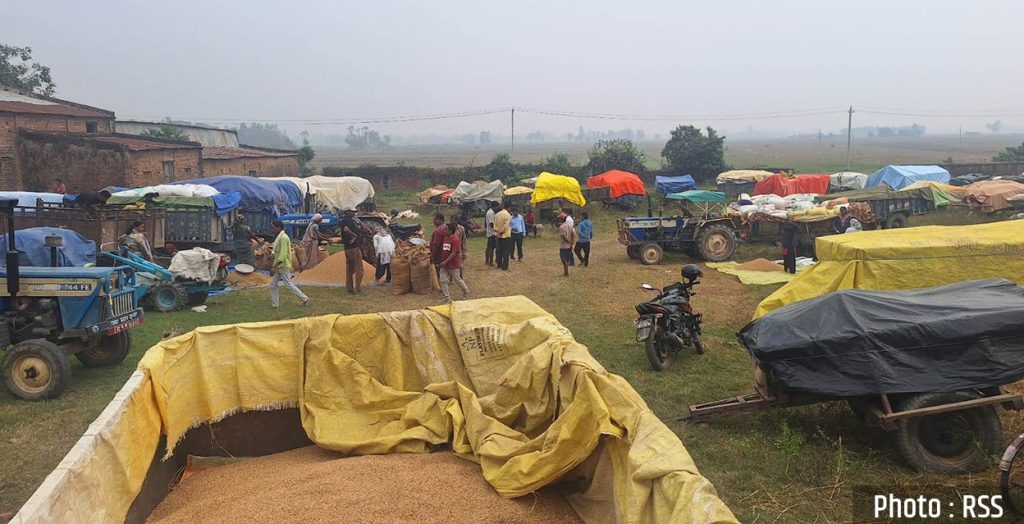
22 October, Kathmandu. With the aim of providing the farmers with a fair price for the produce and maintaining the food balance in the market, the Food Management and Trade Company Limited has started the process of purchasing paddy this year as well.
The company has prepared to start purchasing paddy from the pocket areas where major paddy is produced across the country from the second week of October.
The initial target of the company is to purchase 150,000 quintals of paddy from farmers this year. For this, the company has allocated a budget of around 675 million rupees.
According to Anantaraj Paudel, head of the company's procurement management branch, the necessary administrative work for the paddy procurement process has already started.
"We have written to all relevant offices and chief district officials to hold a meeting of the primary procurement committee for rice procurement," Paudel said, "The rice harvested in the west will take some time to dry due to the recent rains, so the procurement process will start properly between Dasain and Tihar."
In order to organize the purchase of paddy, the company will purchase paddy from major locations in 13 districts this year as in previous years.
Based on the pocket area of paddy production, procurement centers will be operated in Dhangadhi, Mahendranagar, Rajapur, Nepalganj, Jumla, Tulsipur, Bhairahawa, Pokhara, Birgunj, Lahan, Janakpur, Biratnagar and Birtamode.
For the current financial year 2083/84, the government has fixed the minimum support price of coarse paddy at Rs 3,660 per quintal and medium paddy at Rs 3,860 per quintal.
Last year, the government had fixed the support price of coarse paddy at Rs 3,463 per quintal and medium paddy at Rs 3,628 per quintal.
The government has also provided Rs 1 crore for the transportation and facilitation subsidy for the rice procurement program (MSP promotion) this year.
The company has enough godowns to store the purchased paddy. Poudel informed that although there are warehouses with a total capacity of 169,000 tons across the country, about 600,000 quintal capacity warehouses are being prepared for rice storage in the Terai region.
Emphasis on conservation and promotion of Raithane crops
Along with rice, the food company has also given special priority to the purchase of the endangered Raithane crop, which is produced in the hilly and Himalayan districts.
The company has taken a policy to encourage farmers by purchasing crops such as Chino, Kaguno, Phapar, Uva, Jumli Marsi, Beans, Soybean, Besar, Sutho etc.
Paudel informed that the company has allocated a budget of 3.5 million rupees for the purchase of Raithane crops this year. From which, the target is to purchase about 2,500 quintals of Raithane food crops.
According to him, a flexible system has been arranged to allow the primary procurement committee to make a decision on the production of new Raithane crops in any district other than the company's specifications.
"In the past, we implemented Raithane crop purchase program only in Humla, Jumla and Mugu of Karnali, but now we have extended it to Bhojpur, Okhaldhunga, Solukhumbu, Gulmi and other districts in the east," Paudel told Online News.
When Raithane crops are disappearing and people have stopped using them, the company buys them from farmers by paying a little more than the market price.
At the local level, the primary procurement committee, chaired by the Chief District Officer, decides the purchase price based on the market conditions.
"In order to encourage the farmers, we have been buying at a better price than the market price, and when selling to the consumers, we give a discount of Rs.
Similarly, in order to give concessions to consumers, the company has opened a concession shop which was opened only for festivals in the past from this year onwards.
The company said that not only rice, but also pulses, oil, sugar and other daily consumables are provided at concessional rates and there is a good attraction of the consumers.
The company has a commitment to work in the interest of both farmers and consumers as long as the budget allows in the procurement process.